Clinton County Historical Association
This year marks the 25th anniversary of the Valcour Bay Research Project (VBRP). The VBRP was an eight-year archaeological survey of the Valcour Bay lakebed, the site of the historic Battle of Valcour Island.
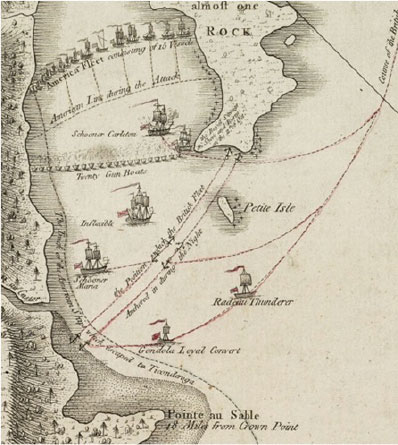
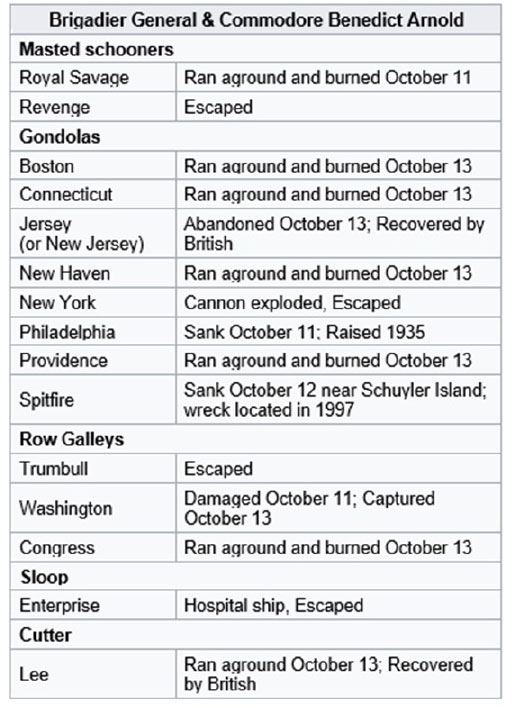
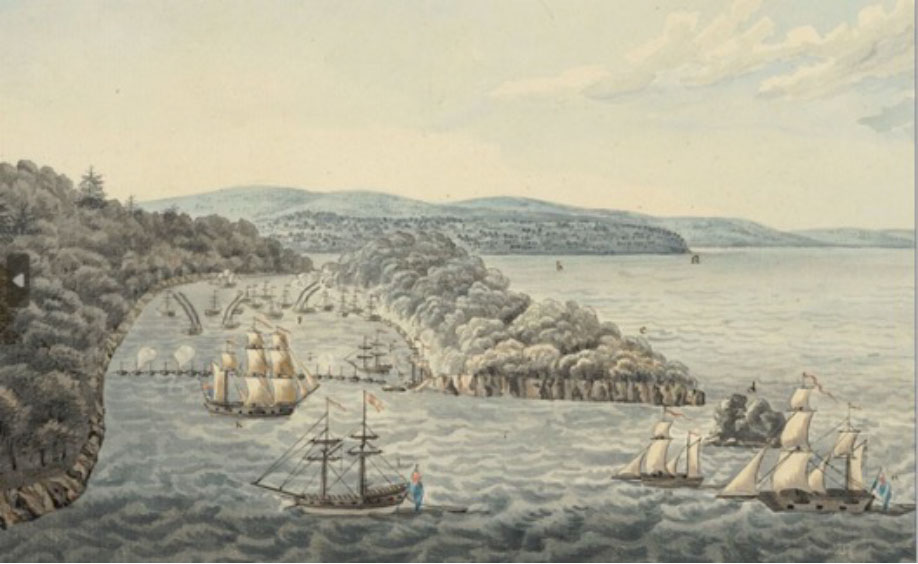
It was at Valcour Bay, on October 11, 1776, that Brigadier General and Commodore Benedict Arnold, attempted to halt the advance of a superior British armada. The British objective was to reduce American defenses at Crown Point and Fort Ticonderoga and ultimately, seize control of the Lake Champlain and Hudson River corridor. The day long battle ended without a clear victor; but in assessing his fleet’s condition and its remaining ammunition, Arnold was not confident it could withstand another day of engagement. In a daring nighttime retreat, Arnold successfully directed thirteen of his surviving ships through the British line.
The fleet had made its escape without notice and had proceeded several miles south before daylight; but their retreat towards Crown Point and Fort Ticonderoga came to an abrupt halt, when a heavy squall blew in from the south. Two of Arnold’s battle-ravaged gunboats, the Spitfire, and the New Jersey, were taking on water and were abandoned by their crews. The New Jersey ultimately became a British prize of war. The Spitfire sank deep within New York waters.
The Spitfire was not to be seen again, until located by side-scan sonar in 1997. A research team, led by Arthur B. Cohn, director and cofounder of the Lake Champlain Maritime Museum (LCMM), and current principal investigator of the Spitfire Discovery Team, came upon the gunboat during a full and comprehensive survey of Lake Champlain. Its discovery made international news and its study, protection, and preservation have been a major focus of Art’s work ever since.
The formation of the VBRP in 1999, was sparked by the discovery of a cannon buried deep within the sediments of Valcour Bay. At the time, I was a Trooper with the New York State Police (NYSP). I was also a diver with their Underwater Recovery Team and made the discovery while practicing with a submersible metal detector. Realizing the gun’s probable historical connection to the Valcour battle and aware of Art Cohn’s research of Arnold’s Valcour fleet, I alerted Art of its discovery. In turn, Art made notifications to officials at the New York State Office of Parks, Recreation and Historic Preservation, as well as those at the U.S. Navy’s Naval History and Heritage Command (NHHC).
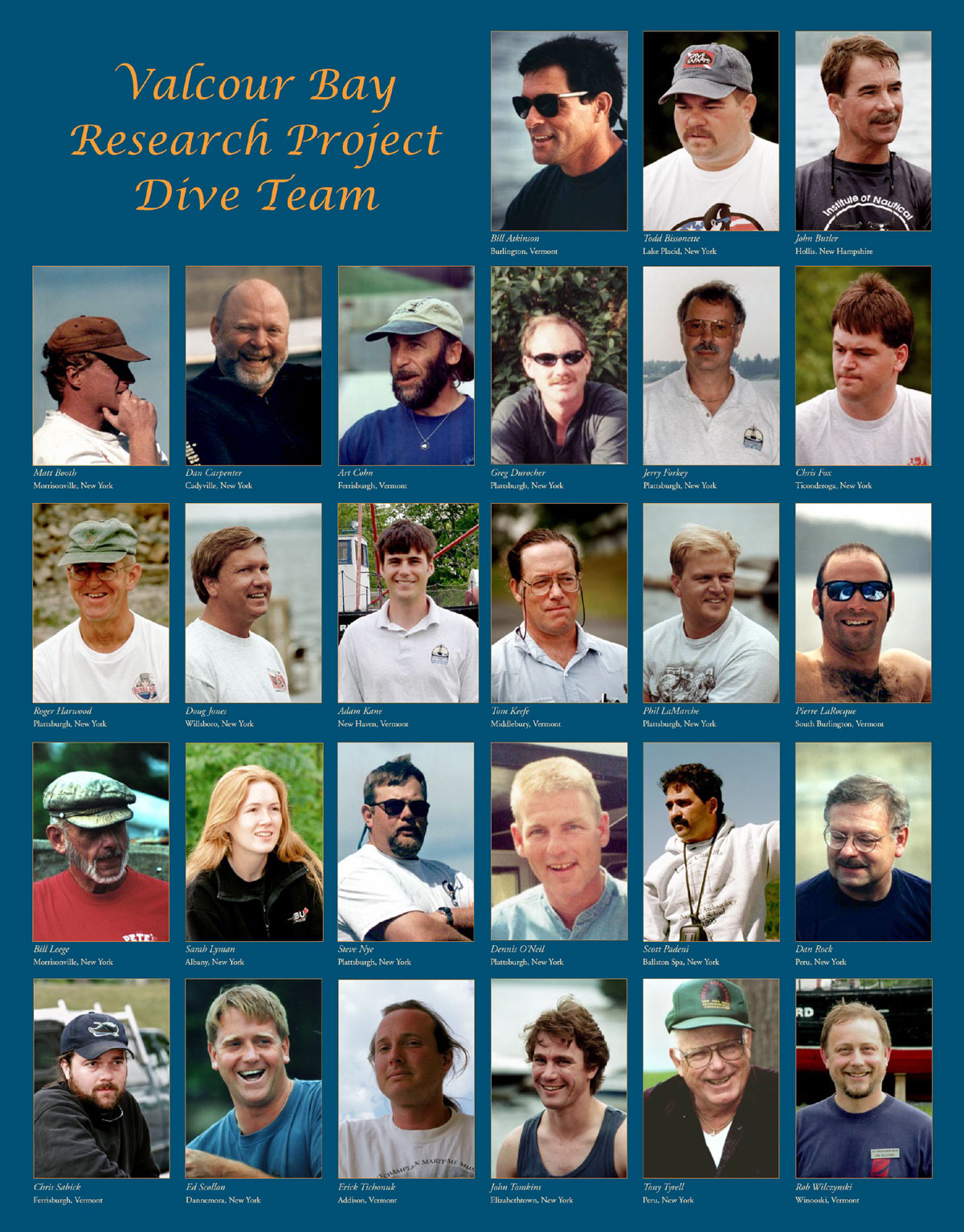
The VBRP was conducted under permits issued by the New York State Museum (NYSM) and NHHC. Recognizing that Valcour Bay’s archaeological record had been irrevocably impacted by decades of relic hunting, Art and I saw the great potential of involving area divers and avocational archaeologists; it was under that thought that the VBRP was formed and organized. The project would channel their interests and skills into a sanctioned, archaeological project, would introduce them to the tenets of submerged cultural resource management and promote a stewardship ethic within the community. Under the issued permits, I was named as co-principal investigator, along with Art. Local, avocational researchers under my direction would conduct the survey throughout the year. Two-week combined surveys, usually conducted mid-summer, would pair the local researchers with LCMM’s professional divers, archaeologists, and associates. Together, our group would survey nearly seven acres of the American line of battle and locate scores of period artifacts.
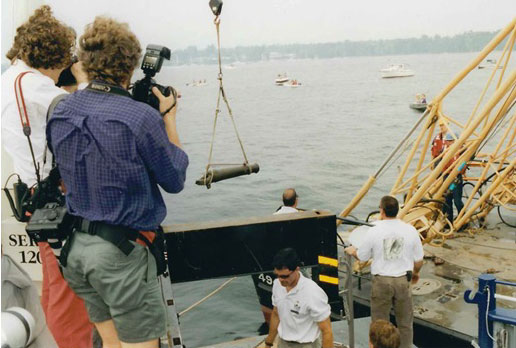
The survey would eventually reveal that the discovered cannon had accidentally fractured during the battle. It was here that Art’s study of the Spitfire would yield huge dividends. The Spitfire Discovery Team had enlisted genealogist and researcher George Quintal to assist the team in confirming the ship’s identity. In a serendipitous discovery of his own, Quintal had recently discovered the pension record of Valcour battle participant Jonas Holden. In his pension application, Holden described the accidental bursting of a cannon aboard the gondola New York. The mishap caused injuries to Holden’s right arm and side.
Over the course of the survey, the VBRP Team located six pieces of the cannon, consisting of approximately ninety percent of the gun. The New York was a gondola, a sister ship of seven others of similar construction within the fleet, including the Spitfire and Philadelphia.
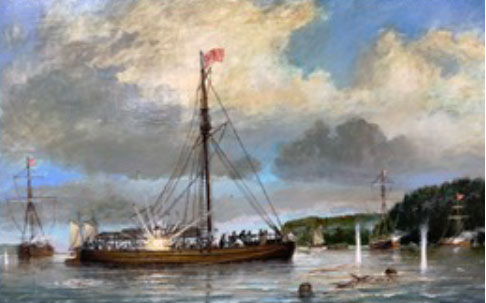
The Philadelphia had sunk shortly after the Valcour battle and was recovered from the bay by salvager Colonel Lorenzo Hagglund in 1935. The ship was ultimately put on display in the Smithsonian Institution in the early 1960’s and has been extensively studied by researchers there ever since. By pairing scaled drawings of the Philadelphia with the project’s recise mapping of encountered artifacts, VBRP researchers could trace the movements of the New York after that tragic accident.
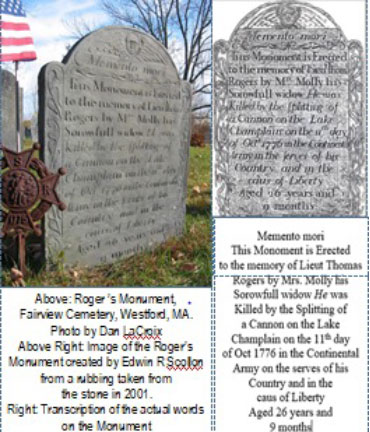
George Quintal would also be able to inform us of the consequences that the gun’s disintegration had for a young Massachusetts family. He had located a monument in Westford’s Fairview Cemetery. The blast had killed Lt. Thomas Rogers. The monument was erected by the family’s only surviving member and is flanked by the graves of his two daughters and one of his nephews; all four were casualties of war or disease, brought on as consequences of America’s struggle for independence.
The artifacts and the historical record fit together like the pieces of a puzzle and a story that had been lost to history re-emerged. The team’s success was a testament to the power of collaboration and the strength of a community’s Involvement in preserving its past.
Art and I have recently partnered with researchers Gary and Ellen Lefebvre of Mallet’s Bay, Vermont. With the Lefebvres’ Research Vessel Amazon, the group intends to conduct a full and comprehensive inspection of Spitfire. The inspection also includes a survey for two heavy cannons that are missing from the gondola’s original armament. That additional survey will retrace the Spitfire’s movements from its current location, back to the American line of battle. The group recognizes that the VBRP and the Spitfire Project are inextricably linked, and this latest survey will be a continuation of both projects. With the approach of the 250th anniversary of American Independence and imminent threats to the long-term preservation of Spitfire, these efforts couldn’t be more fitting or timely.
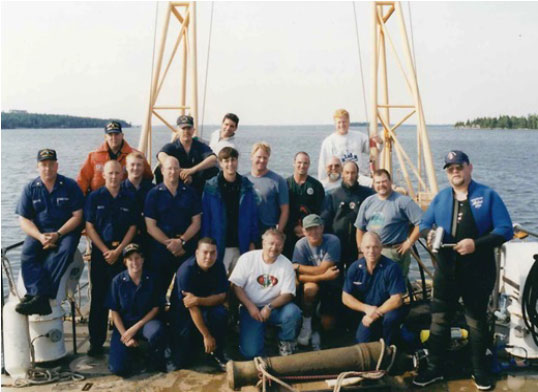
The Spitfire Discovery and VBRP Teams are pleased to have the support of Clinton County Historical Association (CCHA) as an institutional partner.
Authors Bio: Edwin R. Scollon is a retired New York State Trooper and a recent addition to CCHA’s Board of Trustees . Ed continues his work with the VBRP through his involvement in archaeological and archival study, and by making public presentations.