
Clinton County Historical Association
Heritage Corner discusses the life of Daniel Folger Bigelow
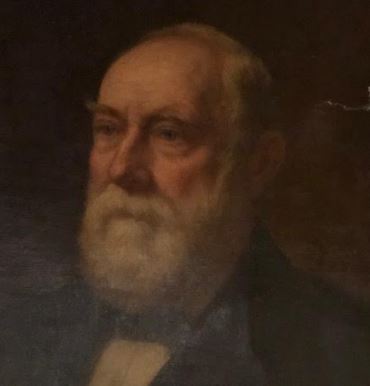
This article was edited from the 1991 Antiquarian written by his granddaughter Caroline Bigelow Gregorvorius and published by the Clinton County Historical Association
Daniel Folger Bigelow, the nationally known landscape painter, was born on a farm in Peru, New York, in 1823. As a child, Daniel stood on a chair and studied a wall painting. Between farm chores, he would sit on a fence and look across Lake Champlain, watching the magnificent change of colors on Mount. Mansfield. His pencil sketches pleased his parents, but they did not take his talent seriously, believing it was an impractical way to make a living. As a teenager, to earn money for paints, he designed leaves and folded hands for gravestones at the local quarry. Some of the old tombstones in the local cemeteries of that era may contain his designs. He also painted some portraits to obtain money for paints, but his first love was nature. When he was young, he met Asahel Powers, the itinerant Vermont folk artist, and portrait painter. He credited Powers for teaching him “the delicacy of colors.” Daniel Folger Bigelow later stated that he had a “passionate love” for the colors of his native northern New York.
When he was 20, Bigelow went to New York City and decided to make painting his life’s work. At 35 years of age, he moved to Chicago and established a studio in the Crosby Opera House. After 13 successful years, his studio and lifelong work were destroyed during the Great Chicago Fire of 1871. He relocated to another studio and rebuilt his career. Although he lived in the Midwest, Bigelow’s painting was influenced by the Hudson River School of design in the East. His brush would paint every leaf, twig, and pebble, using soft misty colors, making his work almost photographic. The art correspondent for the Chicago Tribune in the 1870s labeled his paintings “gems.” During the summer and autumn, he would roam, sketching, through northern New York and New England. He then spent the winter in his Chicago studio, working from his sketches and painting the colors from memory. Nine of these sketches are in the collection at CCHA. Since painted dishes were popular in the Victorian era, Bigelow also spent some time painting beautiful china. Some examples of this work are exhibited at the Clinton County Historical Association Museum. About 1887, Bigelow was asked to become a charter member of the Academy of Design, which developed into the Art Institute of Chicago. He also exhibited at the National Academy of Design, the Philadelphia Centennial of 1876, and the great Chicago Columbian Exposition in 1893.
In 1865 at 41, Bigelow married Charlotte Barnes of Schuyler Falls, the oldest daughter of Dr. Melvin A. Barnes. They had three children, all born in Chicago. The oldest was Folger Allen Bigelow, who was accidentally shot by a friend in 1891 when he was only 23 years old. Folger painted still-life pictures. Folger and Daniel taught and painted together in their Chicago studio. The only daughter, Florence Edgerton Bigelow, painted flowers with watercolors and exhibited them in several galleries around the city. The third child, son Louis Barnes Bigelow, didn’t follow the family tradition as an artist. According to his wife, Charlotte, Daniel Bigelow was a fussy dresser, always wearing neat, clean, starched white shirts—not the typical artist in a soiled smock. The artist had complimentary “press in his lifetime.” He was considered “a delightful man” with a mild manner and a kindly face.
In his 80s, Bigelow was honored at a banquet given by the Society of Artists for his services to art in Chicago. One of the reasons for the popularity of his work in the Midwest was the interest of the new wealthy industrialists and railroad promoters who originally came from the East. They could afford to buy landscapes of New England and scenes of old homesteads they remembered growing up.
Daniel Folger Bigelow painted up to the day he died at 87. For over 50 years, the Adirondack artist recorded the scenery and magnificent colors of his beautiful home country on canvas for posterity.
-This article was edited from the 1991 Antiquarian written by his granddaughter Caroline Bigelow Gregorvorius and published by the Clinton County Historical Association. Copies of the entire piece are available free of charge by emailing director@clintoncountyhistorical.org. A collection of Bigelow paintings, sketches, and china are housed at the CCHA museum.

