
Clinton County Historical Association
Heritage Corner discusses the California Gold Rush
In January of 1848, gold was discovered in California. In February of 1848, the United States annexed the California territory, but the immediate concern was preventing the extension of slavery, not its gold mines. Until late 1848, references to California in the local papers revolved around its admission to the union as a free state. Finally, in early December of 1848, the ‘mineral of wealth’ of California was announced to readers of the Plattsburgh Republican. The report claimed that ‘everyone has his pocket full of gold’ and by the end of December, reports by adventurers were in the news.
Residents of Clinton County were definitely curious about the gold rush in California. Every issue of the Plattsburgh Republican had at least one and often several references to ‘California Gold News’, and it was mostly good news. “Many men who began last June with $50 can now show five to fifteen thousand.” But there were warnings about high prices and the shortage of accommodation. A. C. Moore of Plattsburgh printed a flyer in an effort to organize a company of from 50 to 100 people willing to give 2 years to traveling overland to California. Those interested would need $300, be of good moral character, be accustomed to labor – and be Americans. The company would provide each person with a rifle, horse and the necessary supplies to make the journey. From the flyer wording it looked like the assembly of a working crew whose ‘earnings’ would be collected and deposited each week. There is no further information on this venture, but the flyer is archived at the Kent-Delord House.
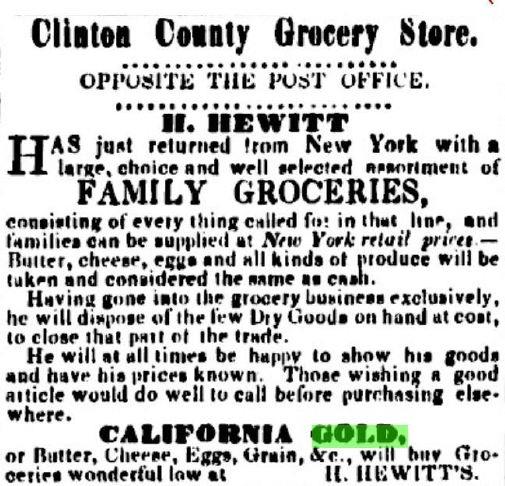
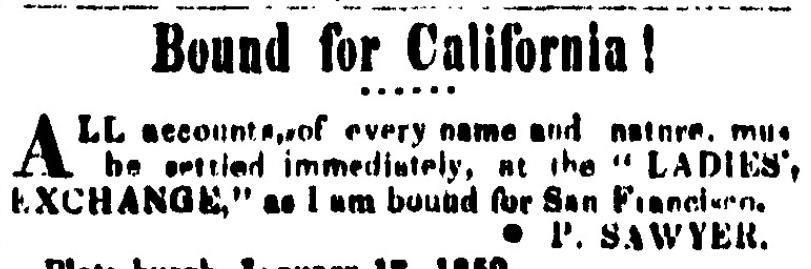
Local merchants took advantage of the attention a bold heading like ‘California Gold Mine’ would bring to their ads. Gold was the headline, but items actually available and sold were just local merchandise like jackets and dresses, even soaps. Store owner H. Hewitt suggested he would accept butter, cheese, eggs and California gold as cash for his merchandise. The Press Republican noted its appreciation for California newspapers sent to them. Plattsburgh lawyer and insurance agent George Moore placed ads for New York Life’s California Life Insurance for “persons bound for California.” Moore continues in 1851 as a Commissioner to ‘take acknowledgements of deeds’ for the state of California. Cabinet Maker William G Brown used a large bold ‘California’ in his ads to say he was contemplating selling everything and was on his way to the land of gold. It was a sales pitch, as he, along with George Moore, go on to sell tickets for a ‘California Passage’ in 1854. The same pitch was put forth for Pomeroy Sawyer’s 1851 end-of-the-year ‘close-out sale’. Pomeroy went on to open a dry goods store in Plattsburgh the following year.
Trips to California were spoken of as adventures, albeit with hazards. To get there, you needed good teeth, a sound body, patience, hope, and a plan on how to get back home. Adventurers were warned about robberies, ‘not of your gold but of your clothing and food.’ The wealth available from the mines was not denied with the caveat that for each person making a fortune, “there are dozens who can scarcely make a living.” And passage was expensive beginning at about $300 minimum and the dedication of two or so years of your life.
There were no easy ways to get to California. Overland was one and it was the option suggested by A. C. Moore for his company of prospectors. Transportation by water, out of New York City, was advertised in the local paper. This trek took months either going via Cape Horn or through Panama with its own hazards. Wallace Bordwell from Champlain went to San Francisco through Panama and reported ‘we engaged small boats to carry us to Gorgona. We then hired mules to ride to Panama . . .you should have seen us mounted on our mules going over mountains that you could scarcely see the tops of . . . to look down and see what a descent you had to make, you’d have thought as I did that the Champlain Roads, with their dust or mud up to the hubs, were far preferable.’ Brodwell had gone from New York to Panama, then after this two-day mountain crossing, took a steamship to San Francisco. This latter part of his journey had taken a month. William Southmayd, a printer from Keeseville, took this trip and drowned on the Chagres in Panama. In March of 1852, there came a warning that thousands of people were in Panama waiting to cross and steamers had deck room only. Deaths were reported to be occurring daily from Panama fever and smallpox.
Miron Spaulding from Black Brook went to California relatively late. He packed up in December of 1855, left his wife and four children, and headed for California. His first letter back home indicated he had arrived in February of 1856. At first, he was sending money home through a friend in Burlington as he felt there were too many post offices around Black Brook, and he wanted to make sure she got the money. His letters shared his busy life, working claims, both his and others, but missing his family and worrying about his children’s health. He loved California and his family and wanted them there, and he started home in the fall of 1857 to retrieve them. On route to Panama, his ship went down. His wife went on to raise the children and letters of his life in California were saved by his daughter Mrs. Harry Booth of Plattsburgh. During the months he spent in California, he sent home $420.
By 1858, public news of the gold rush in our local paper died down. The dentist Dr. Miles stopped describing his gold fillings as ‘California gold’ and goods for gold were rarely offered. References in the newspaper were more on the development of the state, the wars against the natives, and the closure of banking houses. The Clinton County Historical Association would welcome and securely archive for posterity any letters from those brave adventurers from this period.
-Printed in the May and September 1962 issues of North Country Notes and edited by Helen Nerska, Clinton County Historical Association Director

