
Clinton County Historical Association
Heritage Corner discusses the life of Lucy Hobbs Taylor
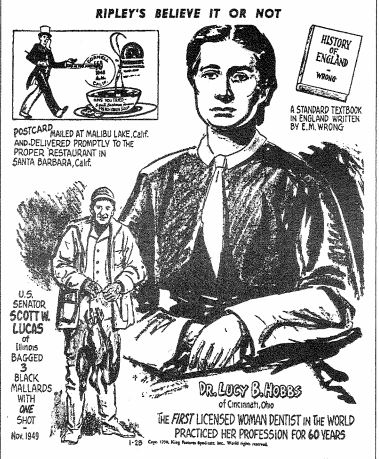
Lucy Beaman Hobbs described her life as the “lone fight of a young girl against the whole world.” Born in Constable, New York, in 1833, raised in Ellenburg and later schooled in Malone, she made it her “mission” to earn her living by the use of her brain, not by the sweat of her brow.
Lucy was the third daughter and seventh child of Benjamin and Lucy Beaman Hobbs. When aged 10, her mother died, and soon after her stepmother died, and we then see her boarding at Franklin Academy where she would study to become a teacher. Sometime, within this experience or because of it, she chose to strike out and in 1849 journeyed west to Brooklyn, a small town of 500 people in southern Michigan. There is no record of whom she travelled with. The journey would have required steamers and stagecoaches.
In Brooklyn, she taught school for 10 years and roomed at the home of Dr. John and Mary Crowell. Under the guidance of Dr. Crowell she began to study medicine. Upon his recommendation, Lucy moved to Cincinnati, Ohio in 1859, and applied to enter the Eclectic Medical Institute but was refused because of her gender. Eclectic medicine was what we would today call ‘alternative medicine’. Dr Charles Cleaveland on faculty at the Institute offered her private tutoring suggesting dentistry, not medicine, and warned that this decision would require her to give up her womanhood.
Credit for Lucy’s decision to become a dentist, however, does not go to Dr. Cleaveland but to Dr. Samuel Wardle, a Mason and Knights Templar, who she felt alone made it possible for women to enter the profession. “His name should be revered by every woman in the profession.” She equated Dr. Wardle’s support to the support Columbus received from Queen Isabella. She had studied all the medical books and now needed the practical training Dr. Wardle offered, while earning money for food and rent by sewing.

In 1861 Lucy applied to the Ohio College of Dental Surgery and was refused because of her gender. Since a degree was not a prerequisite to practice dentistry at the time, Dr. Wardle encouraged her to set up an office in Cincinnati but when the Civil War started, she decided to take her skills farther west. Her next stop was McGregor, Iowa. Here she lived on 25 cents a week after expenses and earned enough to equip her office after one year. In 1865, the Iowa Dental Society admitted her, as the first woman to be a member of any dental society in the US. The Society went on to make a formal application on her behalf for her entry into the Ohio College of Dental Surgery. Later in 1865 she returned to Cincinnati, applied to the College and was accepted. She brought to her studies her experience with her own dental practices and four months later, in February of 1866, she graduated at the top of her class. Lucy was awarded her Doctor of Dental Surgery as the first woman in the world to have graduated from an accredited college with a D.D.S. She would be the only woman in the world to hold this degree for another eight years.
Today the American Association of Women Dentists recognizes outstanding women in the dental profession with the Lucy Hobbs Taylor Award, the most prestigious honor the organization bestows. Ellenburg Center celebrated her achievements with an historic marker. More information on Lucy is in an article by Geraldine E. Napierski in CCHA’s 1999 Antiquarian. Copies are free by emailing director@clintoncountyhistorical.org.

