
Clinton County Historical Association
Heritage Corner discusses the Lyon Mountain Miners Bobsled team
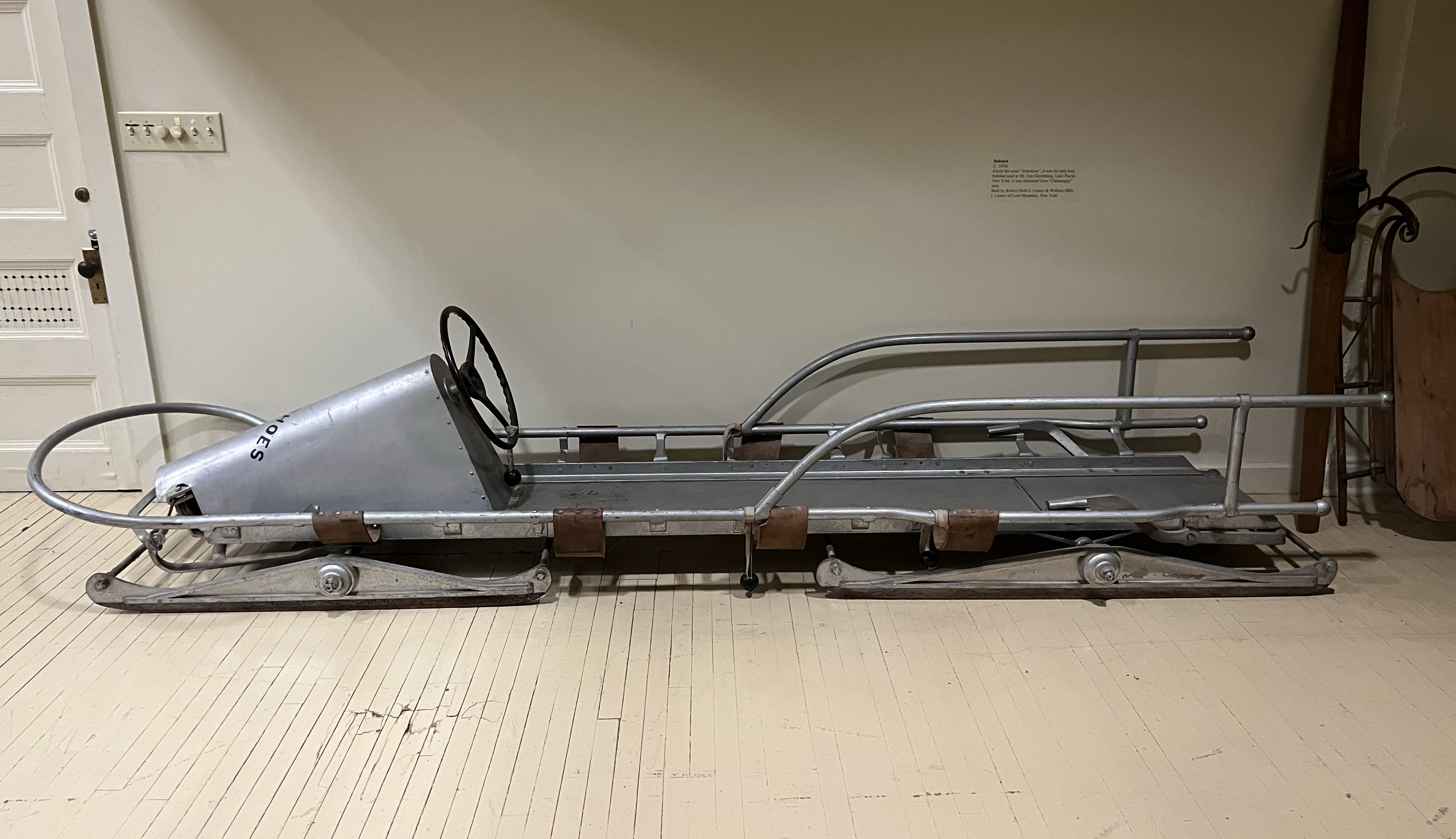
The Lyon Mountain Miners baseball team has attracted the attention of North Country fans throughout the years, but what do you know about the world-renowned bobsled team, the Republic Miners?
Bobsledding competition came to the North Country in 1929 when Lake Placid was chosen to be the site of the 1932 Olympic Winter Games. The Olympic Committee chose Lake Placed under one condition; a bobsled run would be built that could equal any run in Europe. The location chosen for the run was the north side of a 2960-foot peak known as Mt. Van Hoevenberg located eight miles from the Olympic Village of Lake Placid. Stanislaus Zentzytsky, designer of the greatest runs in Europe, was commissioned to design the course. Henry Homburger, of Saranac Lake, supervised its construction. The course was built of earth with rock facing on the curves. The straightaways were six and a half feet wide, and the curves averaged from ten to twenty-five feet in height having steeper drops than those used in Europe. The original course was a mile and a half long and took just five months to build. The venue opened to the public on Christmas Day, 1930.
Following the 1936 season, the course was shortened to one mile in length due to maintenance difficulties. It also eliminated the bowl-shaped “Whiteface” curve. However, the course still contained other hair-raising curves, “Shady” and “Zig Zag”, which were legendary in the bobsledding world.
Bill and Bob Linney, sons of J. R. Linney, Vice President of the Chateaugay Ore and Iron Company, became interested in Bobsledding in the 1930s. Bob Linney designed the first all-metal bobsled. The sled was built in the company shop with runners made of Lyon Mountain iron and a body made of steel. It was found that iron runners caused less drag on the ice than steel. The sled was named “Iron Shoes” and started setting records on the Van Hoevenberg run.
In 1939, Bob Linney’s team won the North American Title for the four-man bob and went on to set a record at the Olympic Trials for the 1940 Winter Games. The Fifth Winter Olympic Games were to be held in Sapporo, Japan. However, the location of the games was changed to St. Moritz, Switzerland due to the Sino-Japanese War. The setting for the games was relocated a third time to Garmisch-Partenkirchen, Germany. The Republic Miners’ Olympic team, made up of Bob Linney (driver), Jack Kerr, Bill Stacavich and Gus Clain, was set to go, to win glory for their country, their town and themselves. Their sled “Iron Shoes” was crated and sitting on the train platform when news came that Germany invaded Poland and the games had been canceled. What an awful disappointment it must have been for the team and the people of Lyon Mountain Village.
Bill Linney took his brother’s place as driver in 1941 when Bob took a new position with Republic Steel. Bill and the Republic Miners set many records throughout the forties, and the Linney bobsled design continued to influence the bobsledding world. Five sleds were built in the shop at Lyon Mountain. Two “Iron Shoes” and one “Iron Clipper” were driven to many victories. There were also two other sleds, a four-man sled called “Iron Miner” and a practice sled named “Iron Shoes Junior” These sleds were never raced.
And how fast is fast? At the 1946 National Senior AAU Championships, during the race for the Billy Fiske Memorial Trophy, a pair of electric eyes were used to clock the speed of the four-man sleds as they crossed the finish line. Bill Linney and the Republic Miners Bill Stacavich, Rufus Brickey and Tom Hicks crossed the finish line at 119.5 miles per hour winning the race and holding the record for that year.
-This month’s CCHA Heritage Corner column was written by Jane Kelting of the Lyon Mountain Mining and Railroad Museum.

