
Clinton County Historical Association
Heritage Corner discusses the San Domingo Improvement Company
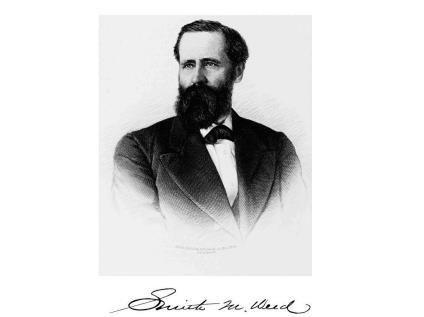
Most people who follow local history know longtime Plattsburgher and Harvard-educated lawyer Smith M. Weed for his involvement in New York State and local government, as well as many local industries in the late 1800s and early 1900s. Others know that he and Andrew Williams were early developers of the Chateaugay ore bed, and that Weed was responsible for numerous improvements in Plattsburgh during his years as a resident of the village and later the city. A civic-minded citizen and philanthropist, he played a prominent role in the community for decades. What some may not know is that Weed diversified his portfolio in a novel way in the mid-1890s during a period of economic hardship in the United States. Surprisingly, he once served as president of the San Domingo Improvement Company, a syndicate that controlled the finances of “San Domingo” (the Dominican Republic today). In that sense, Weed was in charge of what later came to be known as a “banana republic.”
The San Domingo Improvement Company, or SDIC, was founded in 1893, and Smith M. Weed and Charles M. Wells of Plattsburgh served as president and vice president. The government of Santo Domingo (its actual name) was highly unstable during parts of the 1880s and most of the 1890s, so the SDIC was established to reorganize the government’s finances. Before this, a bank in Amsterdam that controlled the finances went bankrupt, and many US businessmen and high-ranking government men stepped in to offer financing.
They lent President Heureaux $1,250,000 (about $47,589,137 in 2025) and also £2,035,000 (about £227,924,148 in 2025) to pay off Amsterdam. Weed’s company was the trustee and holder of the government bonds, and they collected the revenues. They were in charge of the country’s railroads and customs house. As trustees, the company gave the government money to cover running expenses, provided for a “sinking fund,” and “looked after the payment of interest.”
In February 1894, Honorable Edward Hall, originally from Whitehall, the surveyor of the entire Chateaugay Railroad line, was in Santo Domingo and had been there 18 months surveying a line and drawing maps for a 30-mile railroad. When he worked for the company, he was chief of the corps of engineers that surveyed the Chateaugay Railroad and part of the corps that surveyed the Plattsburgh and Dannemora Railroad. He also served as assistant general manager of the Chateaugay Ore and Iron Company before entering politics himself.
Hall was there because Weed and other NY capitalists had invested money, and their business also controlled the country’s railroads. If everything went as planned and Hall’s surveyed line looked good, the investors were going to send John Whalen of Whitehall, the same contractor who built at least part of the Chateaugay Railroad, to Santo Domingo.
If it took Hall 18 months to survey 30 miles for a railroad line, likely through the jungle, it probably made him long for the relative ease of surveying the Chateaugay line, which was not easy. Some of the delay may have been due to bureaucratic holdups. Maybe the area had no prior surveying, and it clearly faced unique environmental challenges. Even so, it is surprising that the work took so long. Hall’s local railroad surveys had been completed in weeks or months, not a year and a half or more, and the local paper reported on the unique Adirondack-related difficulties Hall faced when the Chateaugay Railroad extended from Standish to Loon Lake.
When Weed made his inspection trip in April and early May 1895, they were building a railroad from Puerto Plata on the coast to Santiago, a distance of 45 miles, with 15 miles already completed. Hall was still there overseeing the work. The Drake and Stratton Company was the contractor. Whalen likely built a different line. They expected this railroad to be done by January 1, 1896.
When Weed and Wells made their annual inspection trip in spring 1895, they chartered the Mallory steam liner Van Marcos in Plattsburgh to go to the Caribbean island. While there, they “found it easier” to stay on the boat during their visit. The trip was obligatory.
This venture undoubtedly made Weed more money than his involvement with the Chateaugay ore bed, as the ore and iron markets were fickle and the company faced several major economic downturns over the years.
The money maker for Santo Domingo when Weed was involved was initially the export of goods like sugar and cacao. Later, the economy became dominated by exports of tropical fruits to the United States and Europe. American companies and government men got involved not out of the goodness of their hearts, but to make money. Companies like the SDIC charged high interest rates on their loans, made a lot of money, and took advantage of the system whenever they could. It was known for its high level of corruption, but Weed was in good company if nothing else.
It appeared that Weed and Wells were not very involved in the actual operations within the country and made the inspection trip because they had to, but there was something telling about their finding it easier to sleep on the yacht while they were there. It implied they were probably worried about their health or safety, or that the yacht provided better accommodations than were available in the “improved” country.
One can imagine there were strong feelings among the country’s inhabitants about the owners of these companies. Some companies treated the people of their host countries who worked as laborers horribly, but not enough is known about the SDIC to make a judgment about its treatment of workers. Exploitation on several fronts was common in similar arrangements at the time. The government ended the company’s work in the country in 1903 when it took over more directly, but instability, United States interference, and then direct control plagued it for some time.

